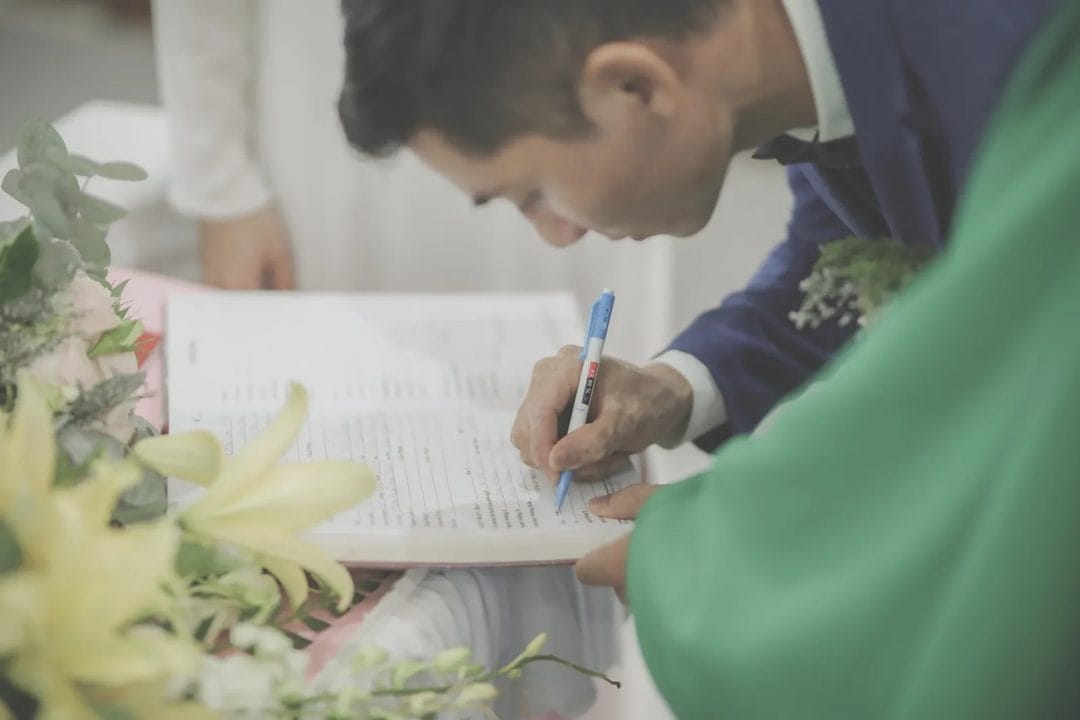
Twenty minutes. That is roughly how long it takes to file a marriage registration at a Korean administrative office once every document in the folder is correct. Getting the folder correct is the part that eats months, and it is where most foreign partners badly underestimate what a Korean wedding actually requires before the ceremony ever gets booked.
Marriage in Korea Is a Registration Event, Not a Ceremony
Here is the detail that catches most newcomers off guard: in South Korea, a marriage becomes legally valid the moment it is entered into the family relations register at the local Si, Gu, Eup or Myeon office — not on the day of the wedding banquet, the church service, or the photo shoot in hanbok. Couples can hold a full ceremony with a hundred guests and still not be legally married if nobody has filed the paperwork. Conversely, two people can register on a random Tuesday afternoon with zero fanfare and be fully, legally married by the time they leave the building. This matters enormously for visa timing, because Korean immigration only recognizes the union from the registration date, not from any ceremony date printed on an invitation.
The office itself does very little on the day. A clerk reviews the submitted documents against the requirements under Korea's Act on Registration of Family Relations, confirms both parties meet the legal age and consent requirements, and stamps the registration. What takes real time is assembling everything that has to be in the folder before that clerk ever sees it — documents that, for the foreign partner, almost always originate outside Korea.
The Document Chain Starts in the Foreign Partner's Home Country
A Korean citizen can pull their own family relations documents from any government office in minutes. The foreign partner cannot — they need to produce a birth certificate and, critically, proof that they are not already married. Many countries have no such thing as a "certificate of no marriage record" sitting in a government database, so applicants from the US, UK, Canada, and most of Western Europe instead swear a single-status affidavit in front of a notary or a consular officer, stating under oath that they are free to marry. That affidavit, along with the birth certificate, is what eventually lands on the desk at the Korean office.
Both documents then need one of two treatments, depending on where they were issued. If the home country is a member of the 1961 Hague Apostille Convention — and South Korea has been a member since 2007 — the documents only need an apostille stamp from the relevant government authority (the UK's Foreign, Commonwealth and Development Office, the US Secretary of State's office in the issuing state, and so on). If the home country never joined the Convention, the documents instead go through full consular legalization: authentication by the home country's foreign ministry, followed by authentication at the Korean embassy or consulate in that country. Skip this step and the Korean office will simply refuse the folder — no exceptions, no appeals process at the counter.
Certified Translation Is Not a Formality
Every document submitted in a language other than Korean needs an accompanying Korean translation, and the office is fussy about who produced it. A bilingual friend's translation, however accurate, routinely gets rejected because it lacks a translator's certification stamp or a notarized statement of accuracy. Use a certified translation agency or a translator affiliated with your embassy in Seoul — not a friend who happens to speak Korean, no matter how fluent they are. Some Korean embassies abroad also offer translation or at least verification services as part of the single-status affidavit process, which can save a separate trip to a translation office once you land.
Name spelling is the quiet killer here. Passports romanize names one way, prior visa documents sometimes romanize them another way, and a translated birth certificate can introduce a third variant if the translator wasn't careful. Any mismatch between how a name appears across the birth certificate, the affidavit, the passport, and the visa application invites a request for clarification — and clarification requests are what turn a two-month process into a four-month one.
Filing at the Si, Gu, Eup or Myeon Office
With the folder complete, both partners show up in person at the office covering the Korean partner's registered address (or, in some cases, either partner's place of residence — staff will confirm jurisdiction on request). The standard submission includes the marriage report form itself, both partners' identification, the Korean partner's family relations certificate, the foreign partner's apostilled or legalized birth certificate and single-status affidavit with certified Korean translations attached, and often two witness signatures, which can usually be provided on the spot by staff or accompanying friends. Processing is quick once the folder is accepted — the marriage is typically entered into the register the same day or within a few business days, and the couple can then request a Certificate of Family Relations (가족관계증명서) showing the marriage, which becomes the master document for everything that follows, immigration included.
The system looks intimidatingly bureaucratic on paper, with its apostilles and certified translations and jurisdictional rules. In practice, once the folder is right, the actual registration is almost anticlimactic: a clerk flips through the pages, checks names against each other, and stamps it. The bureaucracy front-loads itself entirely into the weeks before that appointment, which is exactly why couples who start the affidavit and apostille process the day they decide to marry — rather than the week before — have a much smoother run of it.
The F-6 Marriage Visa: What Immigration Actually Wants
Registering the marriage domestically is a separate process from getting the foreign spouse a visa to live in Korea long-term, and conflating the two is a common mistake. Once the marriage is registered, the foreign spouse applies at a Korean immigration office (or, if still abroad, at a Korean embassy or consulate) for the F-6-1 marriage-based visa. Immigration wants proof that the relationship is genuine, not a paperwork arrangement — photos together over time, chat and call logs, a shared address history, and sometimes a joint bank account or lease agreement all help build that case. The Korean sponsor also needs to demonstrate financial capacity to support the household, measured against an income floor that the immigration service revises periodically, so it is worth checking the current figure on the Hi Korea portal rather than relying on last year's number.
Applicants should also expect to complete or enroll in the Korea Immigration and Integration Program (KIIP), Korea's official Korean-language and culture course, either before applying or shortly after arrival — immigration officers increasingly treat it as evidence of long-term settlement intent rather than an optional extra. An in-person interview at the immigration office is standard for first-time F-6 applicants, and officers do ask basic questions about how the couple met and how they communicate, particularly when the couple doesn't share a first language.
Renewals and the Longer Road to F-5 and Citizenship
The first F-6 visa is usually issued for one year and needs renewing at an immigration office before it expires — don't wait until the final week, since appointment slots at busy offices like Seoul's Yangju or Mokdong centers fill up fast during peak seasons. After several consecutive years of marriage and residence in Korea, spouses become eligible to apply for F-5 permanent residency, which removes the renewal cycle entirely and untethers residence rights from the marriage itself. Spouses of Korean nationals also sit on a simplified naturalization track that is shorter than the general naturalization path available to other foreign residents, reflecting how strongly Korean nationality law treats marriage to a citizen as a settlement pathway rather than a loophole.
One nuance worth flagging: if the marriage ends before permanent residency is granted, F-6 status does not automatically evaporate, but it does become far more fragile, and continued residence generally depends on being able to show the marriage broke down through no fault of the foreign spouse. That is a conversation worth having with an immigration lawyer well before it becomes urgent, not after a separation is already underway.
Where This Goes Wrong
- Single-status affidavits typically stay valid for only three to six months from the date they're notarized — apostille processing, translation, and scheduling an office appointment can easily eat that window, forcing a costly re-swear of the whole document.
- Translations without a certification stamp get rejected at the counter, no matter how accurate they are.
- Couples register the marriage in Korea and assume that's the end of it, forgetting that most home countries also require the marriage to be reported to their own consulate or civil registry — skip this and the marriage may not be recognized back home for tax, inheritance, or benefits purposes.
- Name mismatches between passport, translated documents, and visa forms trigger clarification requests that can add weeks.
- Some applicants assume the F-6 process is a formality once the marriage is registered domestically; it isn't, and treating the immigration interview as a rubber stamp is the fastest way to walk in underprepared.
None of this is designed to be adversarial — the paperwork exists because marriage fraud for visa purposes is a real enough problem that Korean immigration built a genuinely thorough verification process around it. Couples who start the document chain early, use certified translators, and keep every name spelling consistent across the folder tend to find the whole thing tedious rather than difficult. The ones who leave it until a month before the wedding are the ones who end up re-swearing an expired affidavit at an embassy on the other side of the world.