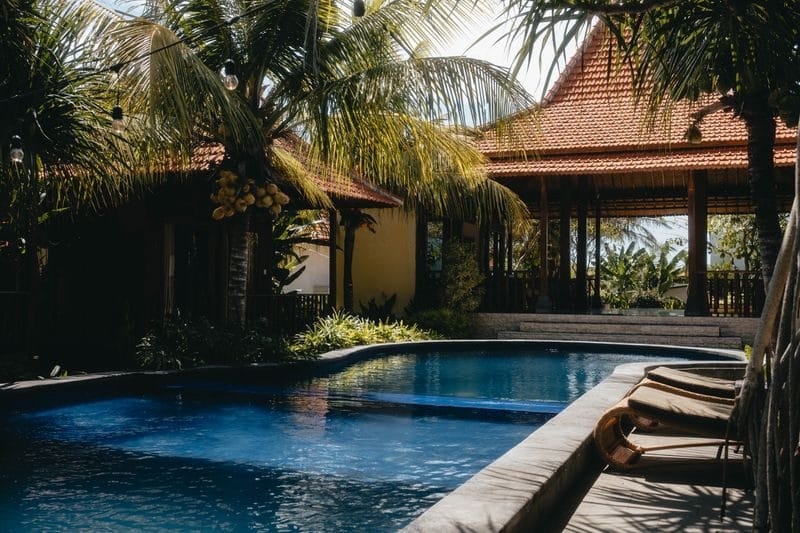
A friend renting a villa in Canggu once told me the worst mistake she made wasn't picking the wrong neighbourhood — it was paying a full year's rent to a landlord she'd met twice, based on a WhatsApp conversation and a walkthrough video, because that's simply how Bali rentals work. Nobody warns you about that upfront. Bali runs on its own logic: visas that don't map neatly onto anything you've dealt with before, a banking system that assumes you already have the paperwork you're there to get, and a property market where owning your own front door isn't actually on the table, no matter how much you're willing to pay.
The Visa Menu Nobody Explains Clearly
Indonesia doesn't have one obvious long-stay route for foreigners the way Thailand or Malaysia do — it has several overlapping ones, and picking wrong costs months. The B211A visit visa is the entry point most people start with: it grants 60 days, extendable twice more at 60 days each, for a maximum stay of 180 days without leaving the country. It's technically a business or social visa, not a work visa, so it doesn't authorise local employment, but immigration agents in Bali process thousands of these a month for remote workers who don't intend to touch the Indonesian job market anyway. Expect to pay an agent 1.2–2.5 million rupiah (roughly £60–£125) to handle the paperwork rather than dealing with the immigration office directly — most people do, because the direct route involves queueing at Kantor Imigrasi in Denpasar with documents in a format the counter staff will reject at least once.
For anyone planning to stay longer than six months, the choice is between a KITAS (a limited stay permit, renewable annually) and the newer Second Home Visa. The E33G remote-worker KITAS, introduced in 2022 specifically for this population, requires proof of at least USD 60,000 in annual income or savings and a contract showing your income comes from outside Indonesia — it's valid for one year and doesn't require a local sponsor company the way older KITAS categories did. The Second Home Visa, by contrast, is a five- or ten-year option that requires parking IDR 2 billion (about £100,000) in a fixed deposit account at a state-owned bank — BNI, Mandiri, BRI or BTN — and that money has to stay there for the visa's duration. It's a serious commitment, and it suits retirees and long-term settlers far better than someone testing out a year in Ubud before deciding.
Why You Can't Actually Own the Villa
Indonesian law reserves full property ownership — Hak Milik — for Indonesian citizens only, and no visa changes that. What foreigners sign instead is a leasehold agreement, usually called sewa or hak sewa, typically running 25 to 30 years with an option to extend, paid either as a lump sum upfront or in structured instalments. This isn't a technicality you can route around with a good lawyer; it's the actual legal ceiling, and any agent who tells you otherwise is either misinformed or selling something that won't hold up if a dispute reaches an Indonesian court.
What catches people off guard is how villa rental itself works even within that leasehold system. Long-term rentals in Canggu or Seminyak are almost always quoted and paid as an annual lump sum rather than month-by-month — a two-bedroom villa in Canggu with a private pool typically runs 250–450 million rupiah a year (roughly £12,500–£22,500), paid in full before you get the keys. Ubud runs noticeably cheaper, often 150–280 million rupiah annually for comparable space, which is part of why it's become the fallback for people whose budget doesn't stretch to the beach areas. Some landlords will accept a six-month split payment if you negotiate before signing, but that's a concession you have to ask for — it's rarely offered.
The Legal Reality of the Villa Contract
Get a bilingual contract reviewed by an independent notary (notaris) before transferring a single rupiah — not the notary the landlord recommends, who has an obvious incentive to move the deal along. This costs somewhere around 1.5–3 million rupiah depending on the property value and complexity, and it's the single best money you'll spend in your first month on the island. Verify the landlord's own certificate — usually a Hak Guna Bangunan or Hak Pakai document — actually exists and matches the person you're paying, because Bali's rental market has enough churn that subletting scams and forged ownership documents aren't rare.
Banking: The Chicken-and-Egg Problem
Opening a full Indonesian bank account with BCA or Mandiri generally requires a KITAS, not just a tourist or B211A visa — so anyone in their first six months on a visit visa is stuck without local banking rails at the exact moment they need to pay a landlord a year's rent in cash or via international transfer. Jenius, the digital-banking app run by BTPN, has become the workaround many expats use once they do have a KITAS: account opening happens largely in-app, and it integrates with Indonesia's QRIS payment system, which now covers everything from warungs to Grab rides. Before that KITAS comes through, Wise remains the standard route for moving larger sums — its rate on IDR transfers typically beats what a UK high-street bank charges by 2–3 percent, which matters considerably more once you're wiring the equivalent of a year's rent rather than a weekly grocery budget.
Cash still dominates more of daily Bali life than most newcomers expect walking in with a Western mindset about card payments. ATM withdrawal limits sit around 2.5–5 million rupiah per transaction depending on the bank, and foreign cards routinely get hit with both your home bank's foreign transaction fee and a local ATM surcharge of 25,000–50,000 rupiah — enough that anyone staying more than a few weeks should prioritise getting local banking sorted rather than running everything through a foreign debit card.
Where the Cost of Living Actually Lands
A single person living comfortably in Canggu — villa rent, a scooter rental at around 900,000–1.5 million rupiah a month, groceries mixing local warungs with imported goods, and the odd coworking day pass — lands somewhere between 15 and 22 million rupiah a month (roughly £750–£1,100), excluding the visa costs themselves. That's meaningfully cheaper than Bangkok's equivalent nomad-friendly budget, and considerably cheaper than Singapore, but it's not the shoestring figure that Bali's old backpacker reputation still implies to people who haven't checked recent prices. Health insurance is worth budgeting separately and generously — Bali's private hospitals, BIMC and Siloam among the most used by expats, handle emergencies competently, but a serious incident without international coverage can run into tens of millions of rupiah fast, and standard travel insurance frequently excludes the motorbike accidents that are, realistically, the most common serious injury among long-stay foreigners here.
The Adjustment Nobody Puts in the Brochure
Rent a scooter and you'll notice within a week that Bali traffic follows an unwritten hierarchy that has nothing to do with signposted rules — bigger vehicles get right of way by default, horns communicate rather than express anger, and the flow through unmarked intersections in Denpasar or Kuta runs on mutual reading of intent rather than signals. It takes most newcomers a month of genuine discomfort before it stops feeling chaotic and starts feeling merely different. Skip the international insurance add-on for scooter rental and you're gambling with exactly the kind of accident that shows up most often in expat medical bills — not worth the daily savings of a few thousand rupiah.
None of this makes Bali harder to relocate to than Bangkok or Ho Chi Minh City — it just runs on a different set of assumptions, and the people who land smoothly are the ones who stop expecting it to behave like the countries they're used to.