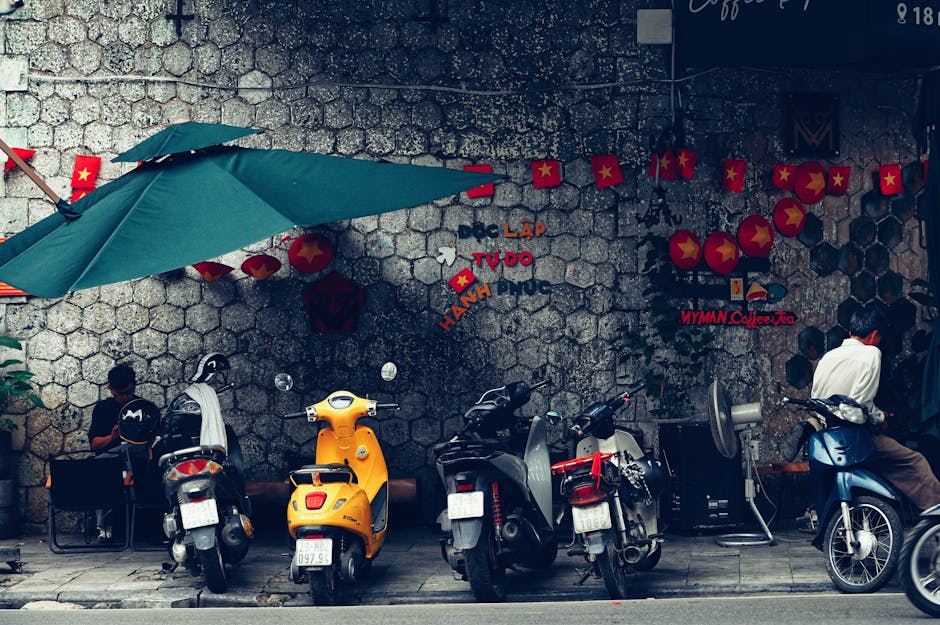
The Seduction
Within two weeks of arriving in Ho Chi Minh City, you will want a motorbike. The reasoning is irresistible: Grab costs add up, the city is designed for two-wheeled transport, your Vietnamese colleagues commute by bike, and the freedom of weaving through traffic on your own schedule is the closest thing to flying that urban transportation offers. Within three weeks, you'll have bought one from a departing expat on a Facebook group for $300–$800. Within four weeks, you'll have had your first near-death experience at a roundabout where the lane markings are suggestions and the right of way belongs to whoever commits most fully to their trajectory. This is the standard expat motorbike trajectory in Southeast Asia, and it's exhilarating, dangerous, and transformative in roughly equal measure.
The Legal Reality Nobody Talks About
In Vietnam, Thailand, Bali, and the Philippines, the vast majority of expats riding motorbikes do not have a valid local motorcycle license. This is the open secret of Southeast Asian expat life. An International Driving Permit (IDP) from your home country covers cars and sometimes motorcycle classes, but only if your home license includes a motorcycle endorsement — and most American, British, and European car licenses don't. Without a valid license, you are technically riding illegally, and your insurance (travel or health) may refuse to cover injuries from a motorcycle accident.
The practical enforcement varies by country. In Vietnam, police rarely stop foreigners on motorbikes — the traffic police infrastructure is overwhelmed by 45 million registered motorbikes, and targeting the occasional expat on a Honda Wave is low priority. In Thailand, police checkpoints targeting motorbikes are common, particularly in tourist areas like Phuket, Chiang Mai, and Pai. The standard fine for riding without a license is ฿500–1,000 ($14–$28), which is minor until you have an accident and your insurance discovers you were unlicensed. In Bali, police checkpoints in Canggu and Seminyak specifically target tourists, with fines of IDR500,000 ($32) and the occasional confiscation of the vehicle.
Getting a Proper License
Getting a local motorcycle license is possible in most Southeast Asian countries and removes the legal ambiguity. In Thailand, the process takes one day at a Department of Land Transport (DLT) office: watch a safety video, pass a written test (available in English), pass a practical riding test on a course, and receive your license. Cost: ฿505 ($14). In Vietnam, the process for foreigners requires a valid visa, health certificate, and passing a theory and practical exam — total cost approximately VND500,000 ($20), though using an agent to navigate the process costs VND2,000,000–3,000,000 ($80–$120). In both countries, the license covers motorbikes under 175cc (most of what expats ride).
Buying: New vs. Used
Vietnam
The most common expat bikes: Honda Wave Alpha (110cc, new: VND18,000,000/$720, used: VND5,000,000–10,000,000/$200–$400) for daily commuting; Honda Air Blade (125cc, new: VND32,000,000/$1,280, used: VND10,000,000–20,000,000/$400–$800) for a step up in comfort; and the Yamaha NVX (155cc, new: VND52,000,000/$2,080) for highway capability. Buying used from a departing expat via Facebook groups ("Saigon Expats" or "Motorbikes for Sale in Saigon") is the standard approach. Check the condition of tires, brakes, chain, and engine oil; take a test ride that includes hills and stops. Transfer of registration (important for resale and police interactions) costs VND100,000–300,000 ($4–$12) at a local notary.
Thailand
Honda Click (125cc, new: ฿55,000/$1,540, used: ฿20,000–35,000/$560–$980) and Honda PCX (150cc, new: ฿82,000/$2,296, used: ฿35,000–55,000/$980–$1,540) dominate the expat market. Buying from a dealer ensures proper registration in your name; buying used from another expat requires transferring the green book (registration document) at a DLT office — bring both passports, the green book, and a sales receipt. Insurance is mandatory (Por Ror Bor, basic third-party: ฿600–1,000/$17–$28 per year) and comprehensive voluntary insurance is available for ฿3,000–8,000 ($84–$224) annually.
Bali/Indonesia
Most expats in Bali rent rather than buy, because the ownership transfer process for foreigners is complicated by restrictions on foreign property ownership that extend to vehicles. Monthly scooter rental: IDR700,000–1,200,000 ($45–$77) for a Honda Vario or Yamaha NMAX. Annual rental agreements bring the cost down to IDR500,000–800,000 ($32–$51) per month. If you plan to stay more than a year, buying through a local nominee (a trusted Indonesian friend who holds the registration in their name) is common but legally precarious — if the relationship sours, the bike is legally theirs.
Safety: The Numbers You Need to Know
Southeast Asia has some of the highest road fatality rates in the world, and motorcycle riders account for 70–80% of road deaths. Thailand alone records approximately 20,000 road deaths annually, the majority involving motorcycles. Vietnam's figure is similar. These aren't abstract statistics — as a motorbike rider in Southeast Asia, you face meaningfully higher injury risk than in almost any other daily activity.
Risk reduction is about gear and behavior, not just luck. Always wear a helmet (a real one with DOT or ECE certification, not the decorative plastic bowls sold at some shops — expect to pay ฿1,500–3,000/$42–$84 for a proper helmet). Wear closed-toe shoes (not flip-flops, which offer zero protection). Consider gloves and a jacket with abrasion resistance (road rash at 40 km/h is a life lesson you'd rather skip). Ride sober — alcohol is the leading contributing factor in motorcycle fatalities across the region, and the temptation to ride home after a night out rather than paying for a Grab is the decision that sends more expats to the hospital than any other.
Ride defensively. Assume every other road user — cars, trucks, other bikes, pedestrians, dogs — will do the unexpected. Maintain a following distance of at least 3 seconds. Never ride faster than 60 km/h in urban areas, regardless of what the traffic flow is doing. Avoid riding at night when visibility drops and drunk driving peaks. And if it rains, pull over and wait. Wet roads reduce tire grip by 50% or more, and the painted lane markings become ice rinks.
The Honest Recommendation
If you're in Southeast Asia for less than six months, use Grab and don't buy a bike. The cost savings don't justify the risk exposure for short stays. If you're staying longer, get a proper license, buy decent safety gear (helmet, gloves, closed shoes), and ride with the respect that a vehicle capable of killing you deserves. The freedom of a motorbike in Southeast Asia is real and addictive — I've had moments on a bike at sunset on a coastal Vietnamese highway that rank among the best experiences of my life. But so are the hospitals, and so are the memorial posts in expat Facebook groups for riders who didn't come home. Take it seriously, or take a Grab.