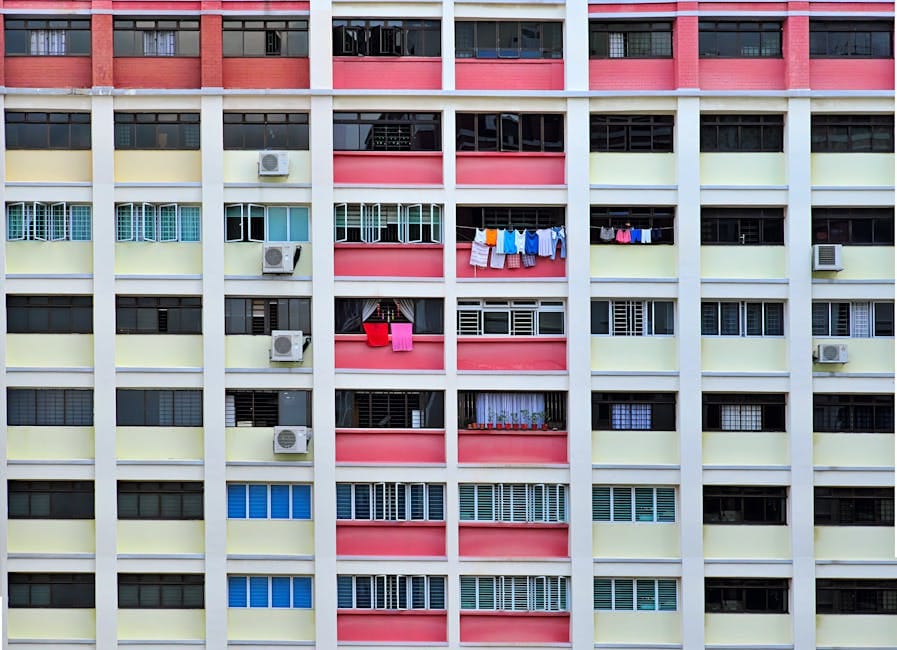
The Three-Tier System
Singapore's housing market divides neatly into three categories that determine not just where you live but how you live: HDB flats (public housing, where 80% of Singaporeans reside), private condominiums (the standard expat choice), and landed properties (houses with their own land, a luxury in a country smaller than most metropolitan areas). As an expat renter, all three are available to you, but the differences in cost, lifestyle, and location are so significant that choosing the wrong tier for your situation can mean either burning money unnecessarily or living in conditions that don't match your expectations. Understanding what each tier actually offers — beyond the real estate agent's sales pitch — is worth more than any apartment-hunting tip.
HDB Flats: The Smart Money Move
HDB flats are government-built apartments that house the vast majority of Singapore's population. They range from studios (35 square meters) to executive apartments (130 square meters) and are distributed across the island in self-contained towns with their own hawker centers, schools, parks, and MRT stations. Foreigners can rent entire HDB flats (though they cannot buy them), and this is where the savings get interesting.
A three-room HDB flat (two bedrooms, roughly 65 square meters) in a non-central area like Jurong, Woodlands, or Tampines rents for S$2,000–$2,800 ($1,480–$2,072) per month. The same-sized unit in a more central location like Queenstown, Toa Payoh, or Bishan costs S$2,500–$3,500 ($1,850–$2,590). Compare this to a similar-sized private condo unit, which runs S$3,500–$5,500 ($2,590–$4,070) in the same areas. The savings of S$1,000–$2,000 ($740–$1,480) per month adds up to S$12,000–$24,000 ($8,880–$17,760) per year — money that could fund vacations, savings, or simply reduce your financial stress.
The trade-off is amenities. HDB flats don't come with pools, gyms, or security guards. The buildings are functional rather than luxurious. The corridors are shared outdoor spaces rather than climate-controlled hallways. Your neighbors include a broader cross-section of Singaporean society, which is either a feature (genuine cultural immersion) or a bug (occasional noise, less privacy) depending on your perspective. For expats who prioritize value and genuine Singapore living over resort-style amenities, HDB is the answer that most real estate agents will try to steer you away from because their commissions are lower.
The Minimum Occupancy Period Rule
HDB flats rented to foreigners have a minimum six-month lease requirement, and the flat owner must have obtained approval from HDB to rent to a non-citizen. Verify this before signing — renting an unapproved unit can result in penalties for both you and the owner. The approval is the owner's responsibility, but confirming it protects you from being asked to leave mid-lease if HDB discovers an unauthorized rental.
Private Condos: The Expat Default
Private condominiums are what most expat relocation guides recommend, and for good reason: they offer a familiar apartment experience with facilities that buffer the adjustment to a new country. A typical Singapore condo includes a swimming pool, gym, BBQ area, function rooms, 24-hour security, and landscaped grounds. Units are larger than HDB equivalents and finished to a higher standard — built-in wardrobes, kitchen islands, balconies, and modern appliances are standard.
Pricing varies enormously by district. A one-bedroom condo (50–65 square meters) in the Core Central Region — Orchard, Marina Bay, Tanjong Pagar — costs S$3,500–$5,500 ($2,590–$4,070). The same in the Rest of Central Region — Tiong Bahru, Novena, Bukit Timah — runs S$2,800–$4,500 ($2,072–$3,330). In the Outside Central Region — Jurong, Punggol, Sengkang — prices drop to S$2,200–$3,500 ($1,628–$2,590). Two-bedroom units add 40–60% to these figures; three-bedrooms add 70–100%.
The condo lifestyle is genuinely enjoyable in Singapore's climate. The pool isn't just an amenity — it's a daily mental health tool in a country where the temperature never drops below 25°C and a 20-minute swim after work resets your entire evening. The gym saves a S$100–$200 monthly gym membership. The security provides peace of mind, especially for families. These amenities have real value that partially justifies the premium over HDB.
Landed Properties: The Status Tier
Landed housing — terraces, semi-detached houses, and bungalows — is the rarest and most expensive housing type in Singapore. Only about 5% of Singapore's housing stock is landed, and foreign ownership is restricted to properties on Sentosa Island. Renting is unrestricted, however, and expat families with generous housing allowances sometimes rent landed homes in neighborhoods like Bukit Timah, Holland Village, Tanglin, and East Coast.
A three-bedroom terrace house in a desirable area rents for S$6,000–$12,000 ($4,440–$8,880) per month. Semi-detached homes run S$8,000–$18,000 ($5,920–$13,320). Bungalows with gardens and pools in the Bukit Timah or Nassim Road area can exceed S$25,000 ($18,500) monthly. These prices limit landed living to senior executives on expat packages that include housing allowances, or independently wealthy individuals. The experience is undeniably pleasant — space, privacy, gardens, and a sense of place that tower living can't replicate — but the cost-to-value ratio makes it hard to recommend for anyone paying out of pocket.
Location Strategy for Expats
Singles and young professionals: Tiong Bahru (hip, walkable, excellent food), Tanjong Pagar (central, nightlife), or Holland Village (expat-friendly, bars and restaurants). Budget S$2,500–$4,000 for a one-bedroom condo.
Couples without kids: Queenstown (near one-north tech hub), East Coast (beach, parks, bike paths), or River Valley (central, near Robertson Quay nightlife). Budget S$3,000–$5,000 for a two-bedroom.
Families with school-age kids: Bukit Timah (near international schools — UWCSEA, SAS, Tanglin Trust), Holland Village (family-friendly, expat community), or East Coast (space, outdoor activities, near UWCSEA East Campus). Budget S$4,500–$8,000 for a three-bedroom condo or S$6,000–$15,000 for landed.
Budget-conscious expats: Jurong, Punggol, or Woodlands HDB. Longer MRT commute (30–50 minutes to CBD) but dramatically lower rent. A three-room HDB in Jurong at S$2,200 provides more than adequate living at a fraction of the CBD price. The savings fund everything from travel to investments to earlier retirement.
The Lease Negotiation
Standard Singapore leases are 12 or 24 months, with a two-month deposit for 12-month leases and three months for 24-month leases. Diplomatic clauses allow early termination (with two months' notice) after 12 months on a 24-month lease, or after 14 months on some contracts — these are standard for expats and should be in every lease. Negotiate hard on: the number of months' deposit (ask for one month instead of two), inclusion of aircon servicing (landlord should cover it quarterly), and specific inventory lists to prevent deposit disputes at move-out.
Rental agents charge commission equivalent to half a month's rent for a one-year lease or one month's rent for a two-year lease. The tenant's agent and landlord's agent split this commission. You can negotiate directly with a landlord to avoid the tenant-side commission, but most condo listings go through agents, making this difficult in practice. PropertyGuru, 99.co, and SRX are the main listing platforms; browse them directly rather than relying solely on an agent's curated selection, which may prioritize their commission over your requirements.
The most important thing about Singapore housing that no guide emphasizes enough: everything in this city is close. Even the "far" neighborhoods are 45 minutes from downtown by MRT. The premium you pay for a central location buys convenience, not necessity. An expat who rents a S$2,200 HDB in Jurong and takes the MRT to work lives essentially the same life as one who pays S$4,500 for a condo in Tanjong Pagar, just with a longer commute and a fatter savings account. Choose based on what you value, not what the relocation industry tells you to value.