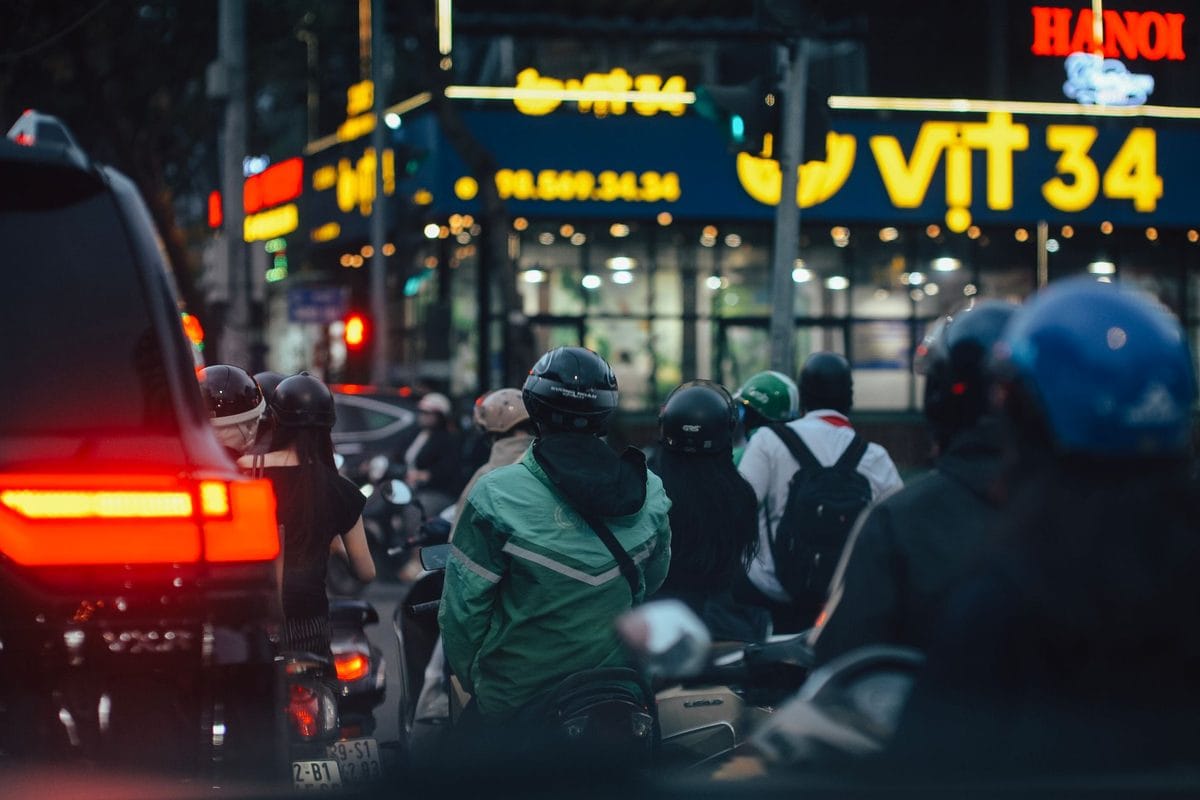
The first thing most new arrivals underestimate in Asia isn't rent or visas. It's the daily friction of simply moving around. You land in Bangkok or Hanoi or Taipei with a vague plan to "figure out transport later," and then later arrives on day three when you're standing in 34°C heat, watching a green taxi refuse to use the meter while three motorbike-taxi drivers wave at you. How you solve mobility shapes your whole first year more than almost any other decision — where you can afford to live, how late you can stay out, whether a weekend trip feels worth the hassle.
This is the part nobody briefs you on properly. So here's how getting around actually works across East and Southeast Asia in 2026, what it costs in local currency, and the licence paperwork that quietly trips people up months after they've settled in.
The licence question comes for everyone eventually
You can ride out the first few months on ride-hailing apps and an International Driving Permit (IDP). The IDP is the paper booklet you get from your home country's automobile association before you fly — it's valid for one year in most of the region and translates your existing licence into a format local police recognise. Get it before you leave. Renewing one from abroad is a genuine headache, and a surprising number of expats only discover theirs has expired when a traffic stop in Chiang Mai turns into a 500–1,000 THB conversation.
The catch with the IDP is that it's tied to your tourist or short-stay status in practice. Once you're a resident — holding a work permit, a long-term visa, or a non-immigrant status — most countries expect you to convert to a local licence. Thailand is the clearest example. With a non-immigrant visa, a residence certificate from immigration (or your embassy), a medical certificate, and your existing licence, you can convert at the Department of Land Transport without retaking the full driving test. You'll sit through a colour-blindness check, a reaction-time test, and a short road-rules video. The first Thai licence is a two-year temporary one; renew it and you get the five-year version. Total cost runs around 1,000–1,500 THB (roughly $28–42), and the real expense is the half-day you'll lose queueing.
Other countries vary more than you'd expect. Japan's conversion — the infamous gaikoku menkyo kirikae — is notoriously strict: drivers from some countries convert on paperwork alone, while others (including the US, where standards differ by state) must pass a practical test on a closed course that even confident drivers fail on the first attempt. South Korea is far gentler; nationals of most countries with a reciprocal agreement swap their licence at a driver's licence agency for around 7,500–10,000 KRW plus a vision test. In Taiwan, if your home country offers reciprocity to Taiwanese drivers, you convert without a road test — otherwise you're booking lessons.
Why the motorbike is the real local currency of Southeast Asia
In Vietnam, Thailand, Indonesia and much of the Philippines, the two-wheeler isn't a hobby or a thrill — it's the circulatory system of daily life. A second-hand Honda Wave or Yamaha in Hanoi costs roughly 15–25 million VND ($590–980); a new automatic scooter like a Honda Vision runs 32–38 million VND. Fuel to cross a city costs less than a coffee. Once you can ride, neighbourhoods that felt impossibly far suddenly become a fifteen-minute hop, and your housing options open up dramatically because you're no longer chained to a metro line.
Here's the part I'd push back on, though, against the chorus of expat forums telling everyone to "just get a bike." If you have no riding experience, Ho Chi Minh City or Hanoi traffic is genuinely one of the most dangerous places on earth to learn. The accident statistics among foreign riders are grim, and a moped spill that would be a scraped knee at home becomes a skin-graft and a medevac claim when you're doing 40 km/h in shorts. If you ride, get a proper helmet (not the plastic shell that comes free with the bike), wear real shoes, and confirm your health insurance covers motorbike accidents — many policies quietly exclude them unless you hold a valid licence for the bike's engine size. That exclusion clause has bankrupted people.
Licensing for two-wheelers is its own track. Thailand issues a separate motorcycle licence, and renting or buying a bike over 50cc without one is technically illegal — police checkpoints near tourist areas know this and price their fines accordingly. In Vietnam the rules around foreign riders and engine sizes above 50cc have tightened, and a licence converted or issued locally is what keeps an insurance claim valid. Treat the licence not as bureaucratic box-ticking but as the thing standing between you and a five-figure hospital bill.
The cities where you genuinely don't need to drive
Not every posting requires you to touch a steering wheel or handlebar. Singapore, Hong Kong, Tokyo, Seoul and Taipei have public transport so good that owning a vehicle is closer to a luxury than a necessity — and in Singapore's case, a deliberately punishing one.
Singapore deserves a specific warning because the numbers shock newcomers. Before you even buy a car, you bid for a Certificate of Entitlement (COE), a ten-year right-to-own permit that has traded well above S$100,000 for larger cars in recent years. Stack that on the car price, road tax, and some of the world's most expensive petrol, and a modest sedan can cross S$200,000 over its life. Meanwhile an MRT ride across the island costs a couple of dollars, and the network reaches almost everywhere you'd realistically need to go. Unless your job demands it, don't buy a car in Singapore. Get an EZ-Link or use SimplyGo on your phone and pocket the difference.
Tokyo and Seoul tell a similar story with a twist: the systems are so dense that the apps matter as much as the trains. In Tokyo you'll live inside Suica and Google Maps; in Seoul a T-money card and Naver Map or KakaoMap, because Google Maps is hobbled for local navigation in South Korea and will route you wrong. Taipei's EasyCard covers metro, buses, the YouBike share scheme, and even convenience-store snacks. These are the cities where car-free isn't a compromise — it's the smarter life.
Ride-hailing: the safety net that has real gaps
Grab in Southeast Asia, Gojek in Indonesia, and the local taxi apps in East Asia are the bridge that gets you through the licence-and-bike learning curve. Grab in particular is more than a taxi button — in Bangkok, Jakarta or Manila it's also how you order food, send a parcel across town, and pay merchants. A typical 6–8 km GrabCar ride in Bangkok runs 120–200 THB ($3.40–5.60); the motorbike-taxi option, GrabBike, costs half that and slices through gridlock, though you're trading a seatbelt for speed.
The gaps are worth naming. Surge pricing during Jakarta's evening rain or a Bangkok downpour can triple your fare in minutes, and that's exactly when no street taxi will stop either. In Japan and South Korea, ride-hailing is regulated very differently — you're mostly summoning licensed taxis through apps like GO or Kakao T rather than the gig-driver model, so prices track the meter and the savings you might expect from Grab simply aren't there. And in smaller cities and rural areas across the region, app coverage thins out fast; the moment you leave the metro core, you're back to negotiating with whoever's parked at the bus station.
What I'd actually do in your first month
If you're landing somewhere with strong transit — Singapore, Hong Kong, Tokyo, Seoul, Taipei — skip the vehicle entirely, load the local transit card and the right map app on day one, and put the money you'd have spent on a car toward a more central apartment. The shorter commute will do more for your quality of life than any vehicle could.
If you're in motorbike country and you'll be staying more than a year, get the IDP before you fly, convert to a local licence once your visa allows it, and if you decide to ride, spend the first month as a passenger learning the unwritten rules of the traffic before you ever take the handlebars yourself. The expats who do well here aren't the boldest riders. They're the ones who treated mobility as something to learn deliberately, the same way they learned the language — one slightly uncomfortable week at a time.