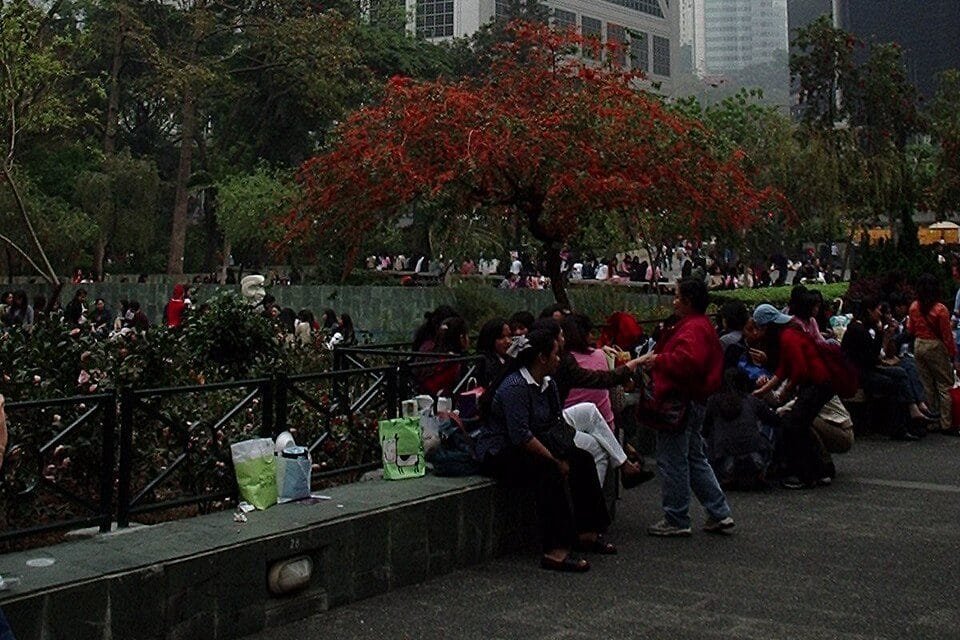
A friend in Singapore spent three weeks buried in Ministry of Manpower paperwork before her new helper from Iloilo could legally move into the spare room. A friend in Bangkok handed a neighbor's cousin 12,000 baht in cash, a spare key, and a verbal agreement about Sundays off. Both of them describe what they did as "hiring domestic help." Only one of them ever touched a government portal.
That split is the first thing to understand before you start asking around your building's WhatsApp group for a cleaner or a nanny. Hong Kong and Singapore run genuine, regulated foreign domestic helper systems, complete with dedicated visa categories, government-set minimum wages, and standard employment contracts that labor departments actually enforce. Almost nowhere else in Asia works this way. In Bangkok, Kuala Lumpur, Shanghai, or Ho Chi Minh City, "hiring help" usually means a private arrangement with a local worker, sometimes brokered by an agency operating with minimal oversight, and the legal protections you assume travel with you from London or Sydney simply don't exist there.
Hong Kong and Singapore: the Only Real Visa Systems
Hong Kong's Foreign Domestic Helper (FDH) scheme has been running since the 1970s and is by far the most institutionalized of its kind in the region. Helpers, overwhelmingly from the Philippines and Indonesia, enter on a dedicated visa tied to a single employer, must live in the employer's home, and are covered by a Standard Employment Contract issued by the Immigration Department. The government sets a Minimum Allowable Wage every year — it has hovered in the HK$4,800 to HK$5,000 range through the mid-2020s — plus a mandatory food allowance if you don't provide meals directly, medical insurance, and a paid flight home at the end of the contract. Singapore's Migrant Domestic Worker (MDW) framework works on a Work Permit rather than a fixed statutory wage, so salaries are negotiated between employer and helper, but in practice first-time helpers from Myanmar or Indonesia commonly land around SG$600 to SG$800 a month, while experienced Filipino helpers with prior Singapore or Hong Kong postings often ask for SG$800 to SG$1,000 or more. Both cities also require a medical checkup for the helper every six months, at the employer's cost, and a failed checkup can trigger repatriation clauses that catch first-time employers completely off guard.
What catches new employers off guard in both cities isn't the salary line — it's everything stacked on top of it. Singapore charges employers a monthly Foreign Domestic Worker levy, which runs lower if you're caring for a young child or an elderly parent and qualify for the concessionary rate, and higher otherwise. Hong Kong requires you to buy a return air ticket, provide either free food or a fixed food allowance around HK$1,200 to HK$1,500 a month, and take out a medical insurance policy meeting a minimum coverage level before the visa is even approved. Agencies in both cities typically charge a placement fee equivalent to one to two months of the helper's salary, and in Hong Kong it is illegal for the agency to also charge the helper more than a capped administrative fee — a rule violated constantly through informal side payments, exactly the kind of arrangement you don't want your name attached to as the sponsoring employer.
What the Standard Contract Actually Requires
- A minimum of one full rest day per week, usually Sunday, which the helper is legally free to spend outside your home
- Live-in accommodation with a degree of privacy — Hong Kong's Immigration Department has rejected renewals over helpers sleeping in a corridor with no partition
- A fixed notice period for termination, generally one month or payment in lieu, on both sides
- Repatriation costs borne by the employer at contract end, not the worker
- In Singapore, mandatory rest day compensation if you ask the helper to work on her designated day off, plus a settling-in program for first-time MDWs
Skip the boilerplate reading of these clauses at your own risk. Hong Kong immigration officers have refused visa renewals over living arrangements that looked perfectly reasonable to the employer but failed the department's own private-space standard, and the appeal process eats months you don't have if your existing helper's contract is expiring.
Everywhere Else: Private Arrangements, Real Consequences
Outside Hong Kong and Singapore, there is no equivalent sponsored visa route for a live-in domestic helper in most of the region — because the person cleaning your apartment or watching your kids is almost always a local national, not a migrant worker on a special permit.
In mainland China, the person you hire is called an ayi (阿姨), and the entire industry runs through local agencies rather than any immigration framework, since ayis are Chinese nationals and no work visa is involved. Shanghai and Beijing agencies typically charge a matching fee of one month's wage plus an ongoing monthly management cut — full-time live-in ayis in Shanghai commonly earn somewhere between RMB 6,000 and RMB 9,000 a month depending on cooking skill and Mandarin-English ability, while part-time cleaning at three or four hours a visit runs closer to RMB 40 to RMB 60 an hour. Malaysia does run a formal foreign domestic worker permit for helpers sourced from Indonesia, Cambodia, or the Philippines, but enforcement is inconsistent enough that a meaningful share of Kuala Lumpur and Penang arrangements still happen informally, leaving both sides with far less recourse if something goes wrong.
Thailand and Vietnam sit at the informal end of the spectrum. Bangkok's condo-dwelling expats mostly hire Thai nationals directly or through small local agencies for part-time cleaning, cooking, or childcare, paid by the hour or the day, with no government contract template and no minimum wage floor specific to domestic work — 300 to 500 baht for a half-day clean is a realistic starting point in most middle-class Bangkok neighborhoods as of the mid-2020s. Ho Chi Minh City works similarly, often through referrals inside expat Facebook groups, and live-in arrangements are rarer there because Vietnamese domestic workers more commonly prefer schedules that let them keep their own household running. None of this is illegal — it's simply unregulated, so the burden of getting the arrangement right sits entirely on you and the person you're hiring. Written agreements are rare, so putting even a short note in writing — hours, tasks, pay day, notice period — heads off the vague misunderstandings that otherwise surface three months in.
What Agencies Don't Volunteer Upfront
Ask any agency directly about their fee structure and you'll get a straight answer. The parts that stay unspoken are usually about what happens after the placement, not before it.
- Transfer fees if you switch helpers mid-contract in Hong Kong or Singapore — these can run close to a full month's salary again, effectively resetting your placement cost
- Whether the agency's contract includes a replacement guarantee if the helper leaves within the first three months, and for how long
- Under-the-table "loan" arrangements some agencies push helpers into before departure, later deducted from salary — against the rules in Hong Kong but persists through informal channels
- Whether the listed monthly fee in mainland China or Malaysia includes the agency's management cut or is purely the worker's take-home pay
Read the agency contract line by line before signing, and ask specifically what happens if the placement falls through in month one — a reputable agency will have a written answer, not a verbal reassurance.
Cultural Norms Nobody Explains
The paperwork is only half the adjustment. The other half is realizing that the household norms you grew up with — how you address someone who works in your home, whether you eat together, how much personal space you assume they want — don't automatically transfer, and assuming they do is the single most common mistake new employers make across the region.
In Hong Kong and Singapore, most helpers prefer being addressed by name rather than by role, and the old habit of eating separately in the kitchen while the family eats in the dining room reads as old-fashioned and faintly insulting to a lot of younger helpers today — plenty of families now eat together as a matter of course, and it's worth asking your helper directly rather than assuming either way. In mainland China, addressing an ayi as "阿姨" is completely normal and not diminishing — it functions closer to "auntie" as a respectful term for an older woman than as a job title, and most ayis use it themselves when introducing their role. Getting this backwards, treating a term of respect as something to avoid out of misplaced Western awkwardness, tends to read as odd rather than considerate.
Privacy cuts both ways in a live-in arrangement, and this is the part first-time employers underestimate the most: your helper needs a genuinely private space and predictable off-hours, but you're also entitled to a household routine that doesn't grind to a halt every time a schedule needs adjusting. The better approach — worth committing to rather than treating as optional — is writing down house rules explicitly in the first week: meal times, guest policy, who handles what cleaning task on which day, and what happens on public holidays that fall on a scheduled workday. Vague verbal understandings are where most disputes start, not from bad faith on either side but from two people quietly assuming different defaults.
Making the Actual Decision
If you're in Hong Kong or Singapore and need genuine full-time childcare or eldercare, sponsor a helper through a licensed agency and use the government's standard contract rather than a hybrid arrangement someone suggests to save on the levy — the enforcement risk of an off-the-books setup in either city is real, and immigration authorities in both have gotten noticeably stricter about it over the past several years. If you're in Bangkok, Kuala Lumpur, or Ho Chi Minh City and only need part-time cleaning or occasional childcare, skip the formal agency route and get a referral through a trusted expat group instead — the informal network in these cities is deep, reliable when vetted properly, and considerably cheaper than layered agency fees that add little value when there's no visa sponsorship involved anyway.
Whatever city you land in, budget for the true cost before you commit to anything, not just the headline hourly or monthly rate. Between placement fees, levies, mandatory insurance, food allowances, and the near-certainty of at least one transfer or replacement in your first two years, the real annual cost of live-in help in Hong Kong or Singapore typically runs 20 to 30 percent above whatever number the agency first quotes you.