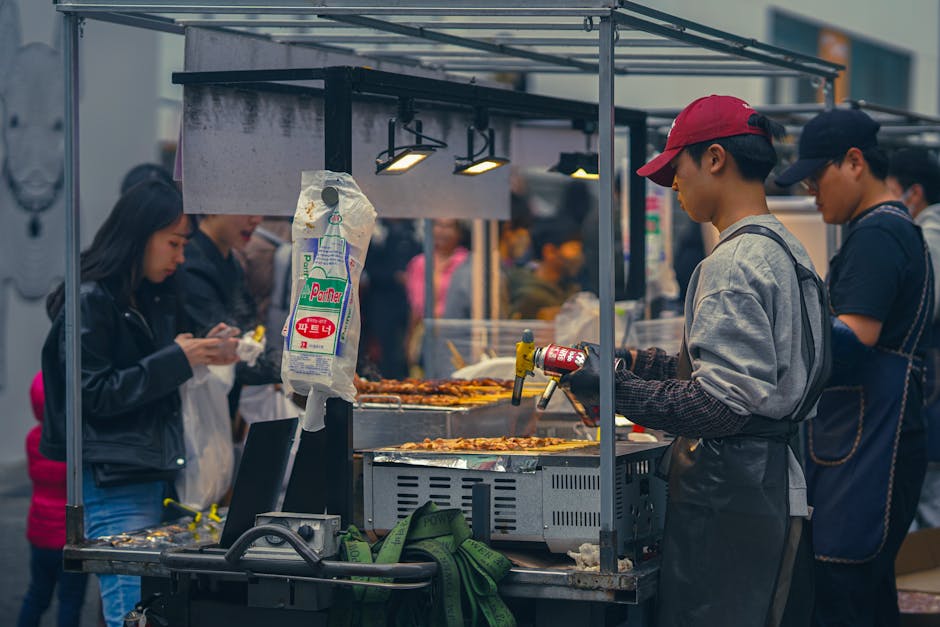
The Sensory Overload
Your first visit to a Korean street food market — whether it's Gwangjang Market in Seoul, Seomun Market in Daegu, or the alley stalls around any university campus — overwhelms every sense simultaneously. Vendors shout over each other, grills sizzle with meat and batter, steam rises from enormous pots, and the smells layer on top of each other: fermented, sweet, smoky, spicy, all at once. The stalls have no English menus. The vendors don't slow down for confused foreigners. And the person behind you in line is definitely annoyed that you're studying the display instead of ordering. This guide exists so you can walk up to any Korean street food stall, point with confidence, and know exactly what you're about to eat.
The Essential Dishes
Tteokbokki (떡볶이) — Spicy Rice Cakes
Cylindrical rice cakes simmered in a thick, sweet-spicy gochujang (red pepper paste) sauce. This is the defining Korean street food — cheap (₩3,000–4,000/$2.22–$2.96), filling, and addictive in a way that makes you crave it at 2 AM. The heat level varies from mild to genuinely painful depending on the vendor. Many stalls add fish cakes (eomuk), boiled eggs, and ramen noodles to the base tteokbokki. Ordering: point and say "tteokbokki hana juseyo" (떡볶이 하나 주세요 — one tteokbokki please). Most vendors serve it in a paper cup with toothpicks. The sauce WILL stain your clothes.
Eomuk (어묵) — Fish Cake Skewers
Thin sheets of fish cake folded onto wooden skewers and simmered in a clear anchovy broth. The fish cake itself is mild and slightly sweet; the broth is the star — rich, warm, and comforting, especially in winter. Vendors often offer small cups of the broth for free alongside your skewer. Price: ₩1,000 ($0.74) per skewer. This is the most gentle introduction to Korean street food for cautious eaters.
Hotteok (호떡) — Sweet Filled Pancakes
A round pancake filled with a mixture of brown sugar, cinnamon, and crushed nuts, pressed flat on a griddle until the outside is crispy and the inside is molten. The first bite releases a stream of hot sugar that will burn the roof of your mouth, which you will entirely deserve for not waiting 30 seconds like the vendor suggested. Hotteok is a winter food — vendors appear from October through March and vanish in warm weather. Price: ₩1,500–2,000 ($1.11–$1.48). Variations include savory hotteok filled with glass noodles and vegetables, but the classic sweet version is the one you want first.
Kimbap (김밥) — Korean Rice Rolls
Seaweed-wrapped rice rolls filled with pickled radish, egg, spinach, carrot, and either ham, tuna, or beef. Kimbap looks like sushi but tastes completely different — the rice is seasoned with sesame oil instead of vinegar, and the fillings are cooked rather than raw. It's the Korean equivalent of a sandwich: portable, affordable (₩2,500–4,000/$1.85–$2.96 per roll), and available everywhere from street stalls to convenience stores. Chamchi (참치) kimbap is tuna, sogogi (소고기) is beef, and yachae (야채) is vegetable. All are good; tuna is the most popular.
Mandu (만두) — Dumplings
Korean dumplings filled with pork, vegetables, glass noodles, and tofu, available steamed (jjin-mandu, 찐만두), pan-fried (gun-mandu, 군만두), or in soup (mandu-guk, 만두국). The steamed version is the most common street food format — served in a paper cup with soy sauce for dipping. Price: ₩3,000–4,000 ($2.22–$2.96) for 4–6 dumplings. Kimchi mandu adds fermented cabbage to the filling and is spicier; gogimandu (고기만두) is meat-heavy. Gwangjang Market in Seoul has a legendary mandu alley where vendors have been making dumplings for 40+ years.
Tornado Potato (회오리감자)
An entire potato spiraled on a stick, deep-fried, and dusted with cheese, honey butter, onion, or barbecue seasoning. It's spectacularly impractical to eat — the spiral extends 30 centimeters from the stick and requires you to bite sideways while potato shards shower your jacket. It exists purely because it's delicious and Instagram-worthy, and Korean street food culture fully embraces both motivations. Price: ₩3,000–4,000 ($2.22–$2.96). Found at markets and festival stalls.
Where to Find the Best Stalls
Seoul
Gwangjang Market: The oldest market in Seoul and the single best street food destination in Korea. The mandu, bindaetteok (mung bean pancakes), and mayak kimbap ("addictive" mini kimbap) are legendary. Go during weekday lunch for manageable crowds; weekend evenings are packed but atmospheric. Nearest metro: Jongno 5-ga (Line 1).
Myeongdong Street Food Alley: Touristy but comprehensive. Every major Korean street food is represented, and some stalls have picture menus with prices in English. Prices are 10–20% higher than local markets, but the variety and accessibility make it worth a first visit. Nearest metro: Myeongdong (Line 4).
Tongin Market: A unique concept — buy brass coins at the entrance (₩5,000/$3.70 for 10 coins) and use them to purchase individual items from different stalls, assembling your own dosirak (lunch box). The most fun way to sample multiple foods without committing to full portions. Nearest metro: Gyeongbokgung (Line 3).
Beyond Seoul
Busan's BIFF Square: Named after the Busan International Film Festival, this area has Korea's best ssiat hotteok (seed-filled sweet pancakes) — thicker, crunchier, and more generously filled than the Seoul version. Also famous for eomuk, which originated in Busan and is subtly different from Seoul's version (wider, thicker fish cake).
Daegu's Seomun Market: Less touristy than Seoul markets, more local character. The flat mandu here are thinner-skinned and more delicate than Gwangjang's robust version. Outstanding napjak mandu (flat dumplings) and kalguksu (knife-cut noodle soup).
Ordering Etiquette
Korean street food ordering is fast and direct. Know what you want before you reach the front of the line. Point at the item and say "hana juseyo" (하나 주세요, one please) or "dul juseyo" (둘 주세요, two please). Pay in cash — most stalls don't accept cards, though this is changing among newer vendors. Don't ask for modifications or special requests; street food stalls are high-volume operations where customization isn't realistic. Eat standing near the stall or walking — there are rarely seats. Dispose of your container in the nearest trash can, which Korea supplies generously.
Tipping doesn't exist in Korean street food culture (or Korean food culture generally). Attempting to tip will create confusion. The correct way to show appreciation is to come back regularly, bring friends, and maybe learn the vendor's name. Korean street food vendors remember regulars, and being recognized at your local tteokbokki stall is one of those small integration victories that makes living in Korea feel like home rather than an extended vacation.