Why Night Markets Exist
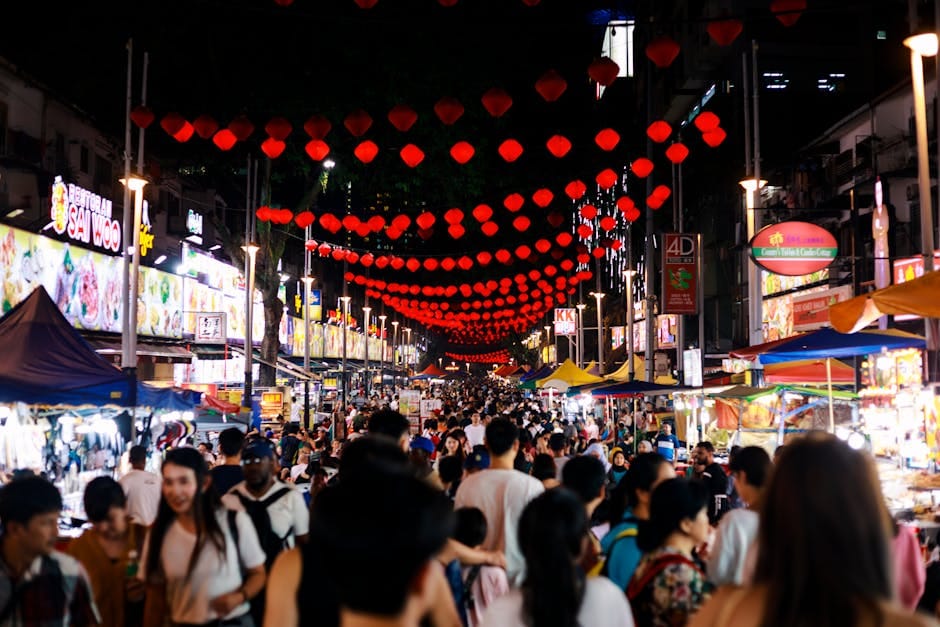
Night markets across Asia aren't tourist attractions that happen to serve food. They're functioning meal infrastructure for millions of urban residents who, after a long day of work in a tropical climate, prefer to eat outdoors in the cooler evening air rather than cooking in a small, hot apartment. The economics work because overhead is minimal — a stall with a portable burner, a few ingredients, and a street-side location generates income that a restaurant with rent, furniture, and air conditioning can't match at the same price point. The result: food that's fresh, fast, affordable, and prepared by specialists who've been making the same three dishes for 20 years. Night markets are where Asian street food reaches its highest expression, and every expat should develop a regular relationship with at least one.
Taipei, Taiwan: The Gold Standard
Taiwan's night markets are arguably the best in Asia — a claim that Thais and Malaysians will dispute vigorously, which is part of the fun. The sheer variety is staggering: a single night market might have 200 stalls offering everything from oyster omelets to coffin bread (thick toast filled with creamy chicken stew, a Tainan specialty) to flame-torched wagyu beef cubes to grilled squid on a stick.
Shilin Night Market (Taipei's largest): Overwhelming in scale, with both an underground food court and street-level stalls. Essential dishes: extra-large fried chicken cutlet (雞排, NT$70/$2.17), oyster omelet (蚵仔煎, NT$65/$2.02), stinky tofu (臭豆腐, NT$50/$1.55), and bubble tea from any of the dozens of tea stands. Go hungry; leave heavy.
Raohe Night Market (more manageable than Shilin): A single covered street running about 600 meters. The black pepper pork bun at the entrance (胡椒餅, NT$60/$1.86) has a permanent line of 20+ people, and it's worth every minute of waiting — a crispy baked bun filled with marinated pork and green onion, cooked in a tandoor-style clay oven. Medicinal stinky tofu (藥膳臭豆腐) at a stall midway through the market is the best version of this divisive dish I've found anywhere.
Ningxia Night Market (the food purist's choice): Smaller, less touristy, focused specifically on food rather than games and shopping. The taro balls, braised pork rice, and oyster vermicelli here are all exceptional and cost NT$40–80 ($1.24–$2.49) per item.
Bangkok, Thailand: The Sprawling Feast
Bangkok's night market scene has shifted in recent years as the city's most famous market, Chatuchak Weekend Market, has been joined by purpose-built night markets that offer a more curated experience.
Jodd Fairs (Ratchadaphisek): Bangkok's current hottest night market, replacing the demolished Train Market with a similar vibe and better organization. The grilled seafood stalls — enormous prawns, crab, squid — are the draw, with prices ranging from ฿100–400 ($2.80–$11.20) depending on size and species. The mango sticky rice here is excellent and costs ฿60 ($1.68).
Chinatown (Yaowarat Road): Not a formal market but a street that transforms into a food destination every evening. The oyster omelets, roasted duck, and bird's nest soup on Yaowarat are the real thing — Chinese-Thai cuisine at its most authentic, cooked by vendors whose families have been on this street for generations.
Seoul, South Korea: The Late-Night Culture
Korean night markets have a different character — more modern, more organized, and heavily influenced by the Korean emphasis on presentation and Instagram-worthiness.
Gwangjang Market (open until 11 PM): Seoul's best food market for traditional Korean street food. The bindaetteok (mung bean pancake) stalls, the knife-cut noodle (kalguksu) vendors, and the raw beef tartare (yukhoe) specialists have been operating in the same spots for decades. Go after 8 PM when the after-work crowd creates the market's best atmosphere.
Myeongdong (the tourist-friendly option): Street food stalls line the main shopping street every evening, selling tteokbokki, tornado potatoes, egg bread (gyeran-bbang), and Korean-style corn dogs (hotdog in batter with potato chunks or ramen crumbs). Prices are tourist-marked-up (₩4,000–6,000/$2.96–$4.44 per item) but the variety and accessibility make it a good first Korean street food experience.
Other Essential Night Markets
Hanoi's Old Quarter (Dong Xuan area, Friday–Sunday evenings): The narrow streets fill with vendors selling pho, banh mi, bun cha, and egg coffee. The chaos of motorbikes, pedestrians, and food carts in the same narrow lane is peak Vietnam — exhilarating and slightly terrifying simultaneously.
Penang's Gurney Drive (George Town, nightly): One of Malaysia's most famous hawker areas. Char kway teow, assam laksa, and rojak prepared by vendors who've been at these stalls for generations. Malaysian hawker food is among Asia's most diverse, blending Malay, Chinese, Indian, and Peranakan traditions, and Gurney Drive showcases this fusion at its best.
Chiang Mai's Sunday Walking Street (Ratchadamnoen Road, Sunday evenings only): Three kilometers of food stalls, craft vendors, and live music stretching from Tha Phae Gate to Wat Phra Singh. Northern Thai specialties — khao soi (curry noodle soup), sai oua (Chiang Mai sausage), and nam prik (chili dip with vegetables) — are the highlights. The once-weekly format creates urgency and atmosphere that daily markets can't match.
Night Market Survival Tips
Go hungry. This sounds obvious, but the mistake most first-timers make is eating a full portion at the first stall that catches their eye and then having no capacity for the better discoveries deeper in the market. Eat small portions from many stalls rather than a full meal from one. Share with friends — night markets are fundamentally social eating experiences.
Carry cash in small denominations. Most stalls don't accept cards (though this is changing in Singapore, Seoul, and Taipei). Carry a pocket full of small bills — Thai 20s and 50s, Taiwanese 50s and 100s, Korean 1,000s and 5,000s. Exact change speeds up transactions and keeps lines moving.
Follow the crowds. The stall with the longest line is usually the best stall. This seems counterintuitive when you're hungry, but the queueing behavior of locals who visit these markets weekly is the most reliable quality signal available. The 20-minute wait for Raohe's pepper pork bun produces a better eating experience than the no-wait stall next door selling a similar product at the same price. Trust the queue.
Go late. Night markets in most Asian cities peak between 8–10 PM. Going at 6 PM gets you early access but misses the energy; going at 10 PM gets you the full atmosphere but some stalls may have sold out of popular items. The sweet spot is arriving at 7:30 PM, making a full loop to scout options, then eating your way back through the stalls you identified during reconnaissance. Treat it as a food adventure, not a dinner — because that's exactly what it is.